transitive verb
US
・UK
A2
abbr.AbbreviationAbbreviation for 'transitive verb,' a verb that requires a direct object.
The abbreviation 'vt.' stands for transitive verb.
n.NounA verb that requires a direct object to complete its meaning.
The verb 'kick' is a transitive verb in the sentence 'He kicked the ball'.
Video subtitles
Learn English Grammar: The Sentence
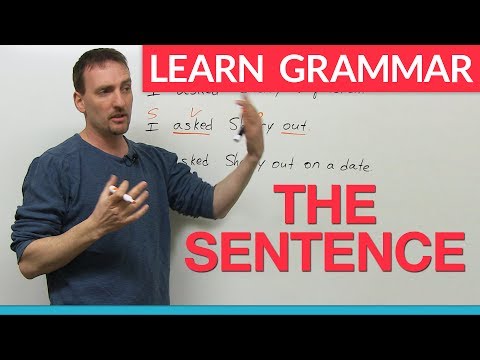
- again, before I get back to the objects, let me explain this word: "transitive verb". I
again, before I get back to the objects, let me explain this word: "transitive verb". I
- word. Understand the meaning of this situation. A transitive verb must take an object, a direct
word. Understand the meaning of this situation. A transitive verb must take an object, a direct
The Word on Language and Grammar with Anne Curzan, Part 4

- transitive verb.
transitive verb.
- So we took lay and created the transitive verb.
So we took lay and created the transitive verb.
Advanced English Grammar: The Infinitive Clause & The Infinitive Phrase

- Now, "to learn" is also not enough because this is a transitive verb.
Now, "to learn" is also not enough because this is a transitive verb.
- Now, "to learn" is also not enough because this is a transitive verb.
Now, "to learn" is also not enough because this is a transitive verb.
Confusing English: LIE or LAY? RAISE, RISE, or ARISE?

- Well, here's the example of transitive verb: "I love".
Well, here's the example of transitive verb: "I love".
- You are my object, my love goes to you. That's what a transitive verb means,
You are my object, my love goes to you. That's what a transitive verb means,
Advanced English Grammar: Dependent Clauses

- But it's a transitive verb, means it can take
an object, so I give it an object. This object
But it's a transitive verb, means it can take an object, so I give it an object. This object
- and I have—but it's a transitive verb, means it can take an object, so I give it an object.
and I have—but it's a transitive verb, means it can take an object, so I give it an object.
Using Proper English - Episode 12 Full HD 1080p

- As a transitive verb, for instance, John fucked Shirley.
As a transitive verb, for instance, John fucked Shirley.
- As a transitive verb for instance:
As a transitive verb for instance:
5 ways to use 'stand' as a verb - English In A Minute

- We can also use 'stand' as a transitive verb which means 'to endure'.
We can also use 'stand' as a transitive verb which means 'to endure'.
Transitive and Intransitive Verbs | Natural English Grammar

- A transitive verb, is a verb that is able to take a direct object after it.
A transitive verb, is a verb that is able to take a direct object after it.
- Compare this with a transitive verb.
Compare this with a transitive verb.
Grammar: How to use TO with transitive verbs
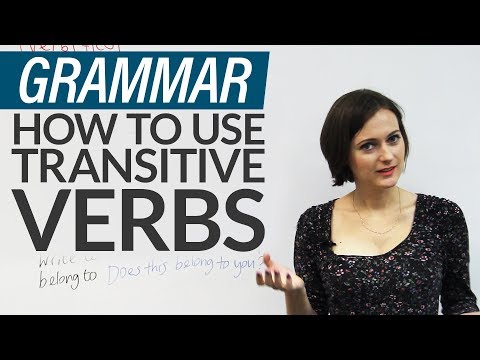
- It's not a transitive verb.
It's not a transitive verb.
Are YOU Saying it WRONG? 5 Highly Common Mistakes in English

- "To like" is a transitive verb, so it needs an object.
"To like" is a transitive verb, so it needs an object.